Electric motorcycle ownership is growing, and workshop decisions are becoming more technical. The International Energy Agency’s Global EV Outlook 2024 estimates that nearly 10 million electric two- and three-wheelers were sold worldwide in 2023. That scale brings a practical question: can a diagnostic tool read the systems fitted to the motorcycle in front of you? Electric motorcycle vehicle diagnostics may involve battery-management data, controller faults, sensor readings, and manufacturer-specific software. A plug that fits is not enough.
The IEA’s Executive Director, Fatih Birol, described the wider shift: “The world is on the cusp of a new industrial age—the age of clean technology manufacturing.” His remark concerns clean-tech manufacturing, not diagnostic tools specifically; treating it as a diagnostic quote would overstate the source. For buyers, the useful test is more concrete. Can the scanner show live battery values beside a service bench? Does it support your motorcycle’s make and model, and can it explain fault codes clearly? Small details matter.
Not every tool does everything. Some offer broad model coverage but limited battery data; others are capable, yet awkward to update. This guide compares seven options by compatibility, functions, usability, and ongoing costs. Check the exact model list before buying. A familiar brand is not a guarantee.
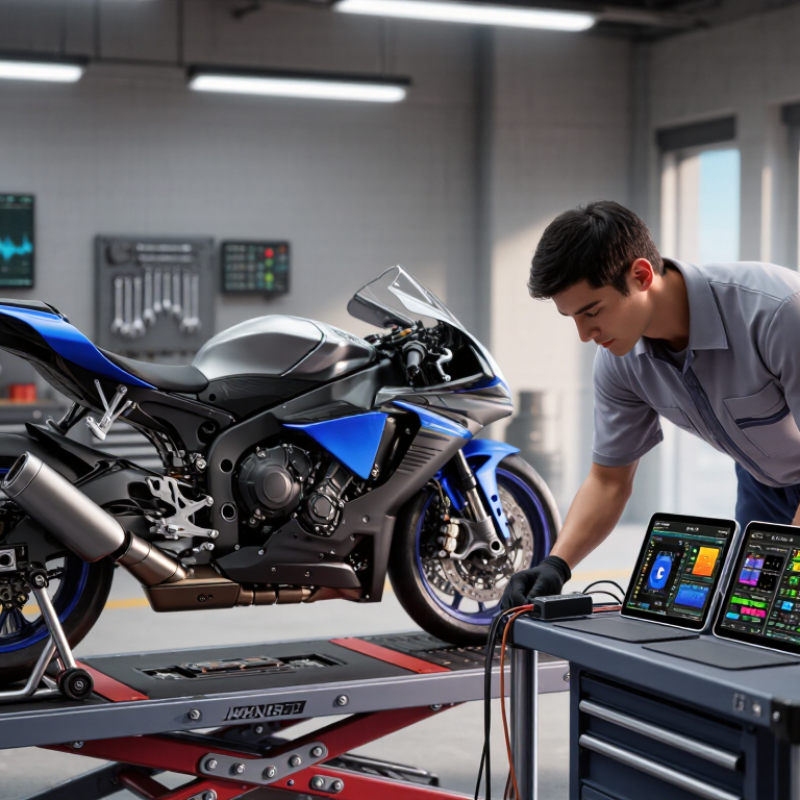
Electric Motorcycle Diagnostics: ECU, Battery, and Charging-System Basics
Electric Motorcycle Diagnostics: ECU, Battery, and Charging-System Basics
Electric motorcycle diagnostics work best when readings are treated as clues, not verdicts. An ECU-compatible tool can display fault codes, live sensor values, and recorded conditions. A throttle-position reading that jumps while the grip moves may suggest a sensor or wiring issue. Codes are clues. Confirm them against the service information for the specific motorcycle, because tool compatibility and displayed data vary by model.
Battery checks need more than a quick voltage glance. State of charge describes available energy; state of health reflects longer-term capacity and wear. Compare scan-tool readings with the maker’s test procedure, and inspect connectors for looseness, moisture, or heat marks. Charging checks should include the charger, cable, charge port, and system-reported charging status. A fault can sit in any link. Avoid probing high-voltage battery terminals unless trained and equipped for that work.
Tips: Record codes and battery readings before clearing anything. Retest after one change at a time; I’ve found rushed parts swapping can hide the original fault. Use insulated tools and the correct service data, and stop if a connector is hot, damaged, or unfamiliar.
Electric Motorcycle Diagnostics: Battery Voltage Reference
Reference voltages for a 20-series lithium-ion pack using 3.6 V nominal and 4.2 V maximum per cell.
A 20-series pack is nominally 72 V and reaches 84 V at 4.2 V per cell. Diagnostic tools can help inspect battery voltage, charging behavior, and ECU fault codes; confirm test limits against the motorcycle’s battery chemistry and manufacturer specifications.
Seven Tool Types Compared by Fault Coverage, Live Data, and Cost
Electric motorcycle diagnostic tools differ in what they can reveal, not just in price. A basic code reader is inexpensive but may miss controller-specific faults. A service tablet can access deeper codes and resets, yet often costs more. A multimeter checks voltage and continuity; it cannot show fault history. A battery analyzer measures cell balance and temperature. Useful, but focused. A CAN bus scanner can trace communication errors, though setup takes experience. A thermal camera spots hot connectors without identifying their cause. Cloud-based fleet tools track live data over time, usually with recurring fees.
Tips: Match the tool to the symptom. Check connector pinouts before probing. Record battery readings at rest and under load. Small details matter.
Compare coverage, live-data depth, and total cost, including subscriptions and compatible cables. A live-data screen may show pack voltage, motor temperature, or throttle position, but not every system exposes those values. In practice, readings need context: a brief voltage dip under acceleration can be normal, while a repeated drop deserves investigation. I have found that broad coverage sounds reassuring, but unsupported models still leave gaps. Check compatibility against the motorcycle’s exact year and controller type before buying.
Protocol Compatibility: CAN 2.0B Supports Bit Rates Up to 1 Mbit/s
CAN 2.0B support can be a useful filter when comparing electric motorcycle diagnostic tools.
It allows extended CAN identifiers and commonly supports bit rates up to 1 Mbit/s. That ceiling does not mean every motorcycle communicates at that speed. The bike’s control units and the diagnostic interface must use compatible settings.
Check the tool’s documented protocol options, not just a “CAN compatible” label. Some systems operate at lower bit rates, while connector pinouts and diagnostic messages can vary by motorcycle.
A practical test starts with the service information: confirm the port location, wiring, and required communication settings before connecting a scanner. Check the wiring. If the tool connects but returns no data, the issue may be an unsupported message format rather than a faulty control unit. That distinction saves guesswork.
In real workshop use, a clear connection status and readable error details are more helpful than a long feature list. Still, compatibility claims can be vague; I would verify them with the seller or technical documentation before buying. A 1 Mbit/s rating is useful, but it is only one part of fit.
Buyer Checks: OEM Coverage, Updates, Voltage Ratings, and Safety
Electric motorcycle diagnostics are no longer a niche workshop purchase. The International Energy Agency’s Global EV Outlook 2024 estimates that nearly 10 million electric two- and three-wheelers were sold in 2023, about one-fifth of global sales. More models mean more variation in controllers, battery systems, and communication protocols. Check coverage against the exact model year, not just the motorcycle’s voltage. Ask whether the tool reads live battery data, fault codes, and brake-system faults, or only clears warnings. That distinction matters. A spec sheet can still flatter the tool.
Updates deserve equal scrutiny. Confirm how often software and vehicle coverage are refreshed, whether updates require a subscription, and what happens if internet access fails in a workshop. For voltage ratings, compare the tool’s stated maximum DC working voltage with the motorcycle’s maximum pack voltage, not its everyday reading. Inspect lead insulation and connectors before use. Never probe a high-voltage circuit unless the equipment and procedure are explicitly rated for it and the operator is trained. A careful buyer should also check for clear isolation instructions. I’d still want to see the manual before trusting a safety claim; product pages rarely show the whole procedure.
Choosing a Tool by Workshop Needs, Skill Level, and Motorcycle Brand
Choosing among the 7 best electric motorcycle diagnostic tools starts with the work you actually do. A small workshop may need clear fault codes, live battery readings, and guided tests. A mobile mechanic may value a compact unit and quick connector access. IEA’s Global EV Outlook 2024 reports about 9 million electric two- and three-wheelers sold in 2023, roughly one-fifth of global sales. That growing variety makes broad vehicle coverage useful, but not always essential.
Skill level changes what “useful” means. New technicians benefit from plain-language explanations and step-by-step checks. Experienced staff may prefer live data, component tests, and the ability to compare readings. Look for functions that match your routine: checking battery state after a cold start, tracing a sensor fault, or confirming a repair. Keep it practical. A long feature list can look impressive and still slow down a busy bench.
Motorcycle brand coverage deserves a careful check before purchase. Confirm support for the exact model year, connector type, and system—not just the manufacturer name. IEA figures describe market growth, not repair complexity, so they cannot tell you which tool fits your shop. Ask how often updates arrive and whether the tool covers battery, motor, and controller faults. I still find connector access easy to underestimate. Verify it against a motorcycle you service often.
Conclusion
Electric motorcycle vehicle diagnostics helps buyers understand faults across the electronic control unit, battery, and charging system. Diagnostic tools differ in the issues they can detect, the live data they display, and their cost. Some provide basic fault-code reading, while more capable options may offer deeper system checks and real-time information to support troubleshooting.
Before choosing a tool, check that its software covers the motorcycle’s systems and that updates are available. Confirm voltage ratings and follow safe connection procedures. Protocol support also matters: CAN 2.0B can operate at bit rates up to 1 Mbit/s, but compatibility depends on the motorcycle and diagnostic device. The right choice should match the workshop’s needs, the user’s experience, and the motorcycle’s make, balancing useful coverage with ease of use and overall cost.